Architecture
AgentVisor™ uses a host-guest architecture that provides strong security boundaries while maintaining compatibility with standard HTTP libraries.
Overview
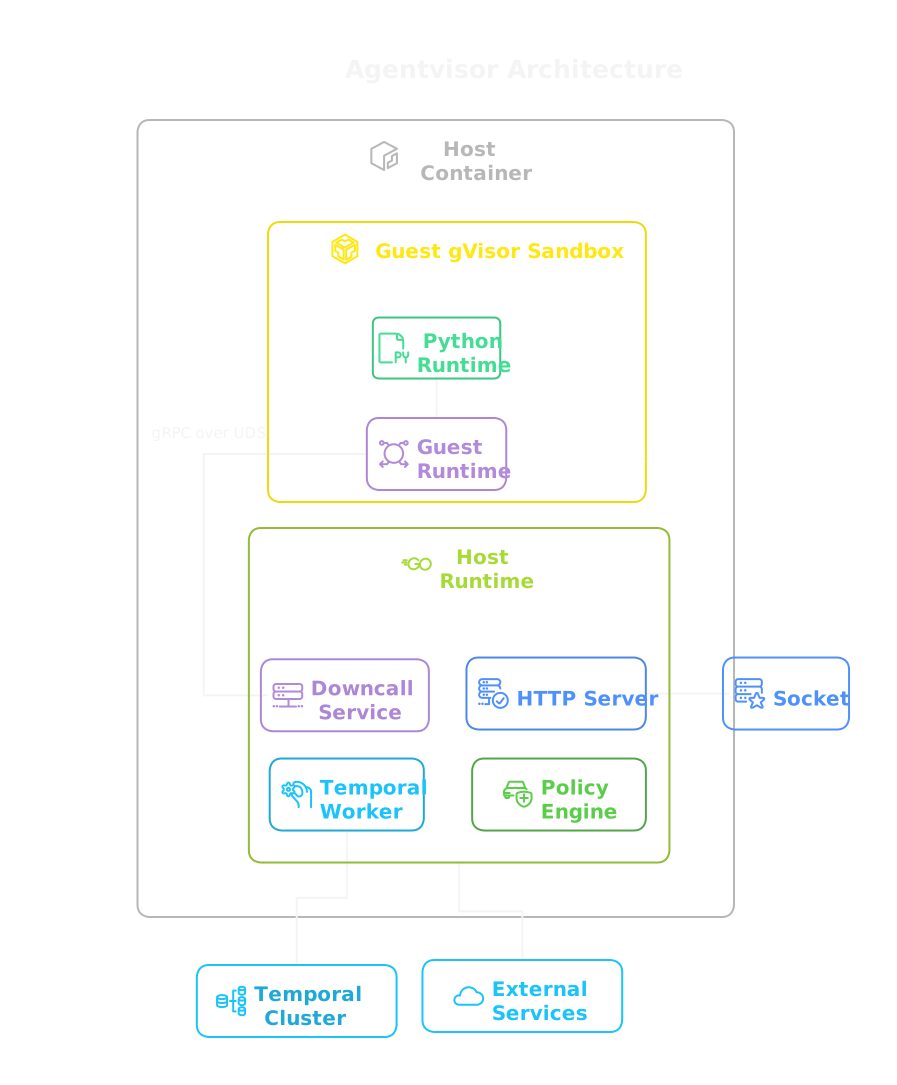
Components
Guest Sandbox
The guest sandbox is an isolated environment where agent code runs.
Security Properties:
- No direct network access outside the hostlink channel (
--network=noneon gVisor/Docker-Linux; nftables-restricted egress to the hostlink address on Docker macOS/Windows — see Sandbox Modes) - All syscalls intercepted by gVisor (in gVisor mode) or filtered via seccomp (Docker mode)
- Filesystem isolation
- Resource limits (memory, CPU, processes) — enforced in Docker mode, and in gVisor mode when the host runtime runs as root with a writable cgroup v2 mount; otherwise apply them to the outer container or pod
- Credentials never enter the sandbox (symbolic token substitution via credential brokering)
- Per-agent UID isolation prevents cross-tenant access (gVisor and Docker modes)
Contents:
- Agent code and its runtime dependencies
- Guest runtime (Go binary)
- Mounted Unix socket for host communication
Guest Runtime
A small process inside the sandbox that:
- Runs an HTTP proxy and forces
HTTP_PROXY/HTTPS_PROXYinto the agent's environment so all agent HTTP traffic is intercepted - Forwards intercepted requests to the host runtime over the hostlink session (UDS or TCP+mTLS, depending on sandbox mode)
- Hosts a per-agent control socket the SDK consumes (the SDK exposes Python APIs like
agentvisor.store,agentvisor.checkpoint,agentvisor.langgraph.AgentVisorCheckpointer; agent code never deals with the channel directly) - Stamps every agent-originated request with authoritative identity (
thread_id,principal,run_id) before forwarding to the host — agents cannot spoof identity through this path
Host Runtime
The trusted component running outside the sandbox:
- Control plane: receives the guest's policy/checkpoint/store/etc. requests over the hostlink session, and drives the guest's lifecycle in the reverse direction
- HTTP Proxy: makes authorized external requests on the agent's behalf
- PolicyEngine: evaluates access policies
- Temporal Worker: manages durable workflows
- Lifecycle Manager: starts/stops guest sandboxes
- Credential Resolver: substitutes symbolic tokens with real credentials at the outbound boundary
- API Transports: multi-protocol access for external clients (REST, MCP, A2A)
- MCP and A2A Gateways: outbound connections to external MCP servers and A2A agents on behalf of agents
- Trace Collector Client: optional outbound stream of gVisor seccheck syscall events (enriched with thread/principal/agent context) to an external security-monitoring collector
Communication Protocol
Internal communication moves over a private control channel that connects three components. Users do not interact with this channel directly — language SDKs (Python's agentvisor.* packages and equivalents) abstract it.
Agent process ↔ Guest runtime. A per-agent socket inside the sandbox. The SDK consumes this for everything an agent needs to coordinate with AgentVisor — saving/loading checkpoints, key-value store access, per-thread state, MCP/A2A gateway calls, log forwarding, telemetry. Agent code never opens the socket directly; it calls SDK functions.
Guest runtime ↔ Host runtime. Every action that crosses the sandbox boundary is forwarded over the hostlink session — HTTP proxy traffic (including streaming and WebSocket upgrades), checkpoint/state operations, store/MCP/A2A calls, log and span forwarding, and policy pre-checks for raw network connect attempts. The guest runtime always re-stamps the request with authoritative identity (thread, principal, run) before forwarding; agents cannot spoof identity over this path.
Host runtime ↔ Guest runtime. The same hostlink session is used in the reverse direction for invoking agents, cancelling runs, snapshotting and restoring durable state, signal delivery, environment configuration, lifecycle (shutdown / health check), and bridging interactive terminal sessions for agentvisor exec.
A separate outbound trace stream is also available for security monitoring: when configured, the host runtime acts as a client to an external trace-collector service, forwarding gVisor seccheck syscall events enriched with thread/principal/agent context. The collector itself is implemented by an external system (e.g., a SIEM or security-monitoring platform), not by AgentVisor.
Hostlink Session
Host and guest communicate via a single multiplexed connection — the hostlink session — that carries both directions of host↔guest traffic. The wire-level transport depends on the sandbox mode and host OS:
| Mode | Host OS | Transport | Security |
|---|---|---|---|
none, gvisor | any | Unix domain socket (UDS) | OS-level isolation — no TLS needed |
docker | Linux | Unix domain socket (UDS) | OS-level isolation — no TLS needed |
docker | macOS / Windows | TCP + mTLS via host.docker.internal | Ephemeral CA generates short-lived client/server certs |
This single connection is bind-mounted (UDS) or addressed via host.docker.internal (TCP), providing the only communication path between guest and host. The agent process never reaches the hostlink directly — its requests pass through the guest runtime, which stamps identity on every forwarded message.
Exec Mode
agentvisor exec is an alternative execution model that bypasses Temporal workflows and the HTTP API entirely. Instead of invoking an agent in response to an HTTP run request, the host bridges its own stdin/stdout into the sandbox so the user has an interactive terminal session inside it. All policy enforcement (HTTP proxy, MCP, A2A, store) remains active — only the orchestration layer is removed. This makes exec suitable for interactive tools like Claude Code, shells, or Cursor that expect a persistent TTY rather than a request/response API.
Trust Boundaries
The key insight: agent code cannot escape the sandbox. It has no route out except the hostlink session (UDS or TCP+mTLS, depending on sandbox mode), where every request is policy-checked. This boundary is what makes the agent confined rather than merely isolated: the policy, the decision point, and the record all sit on the trusted side. See Confinement.
API Transport Architecture
AgentVisor supports multiple API transports through a pluggable provider system. All transports share a single HTTP server, TLS configuration, and authentication middleware.
Supported Transports
| Transport | Endpoint(s) | Protocol | Description |
|---|---|---|---|
| OpenAPI/REST | /* | HTTP/REST | LangGraph Agent Protocol v0.2.0 |
| MCP | POST /mcp, GET /mcp | JSON-RPC 2.0 over HTTP, with SSE notifications | Model Context Protocol for tool access |
| A2A | POST /a2a, GET /.well-known/agent-card.json | JSON-RPC 2.0 | Google Agent-to-Agent Protocol (with standard agent-card discovery path) |
Single Server Design
All transports are served from a single HTTP server on the configured listen address (default :8090). This provides:
- Simplified deployment: Single port to expose
- Consistent TLS termination: One certificate configuration
- Shared authentication: Common middleware for all protocols
- Transport isolation: Each protocol registers its own routes
Transport Provider Pattern
Transports use a pluggable provider model — each transport (OpenAPI, MCP, A2A) registers its own routes on the shared HTTP mux and can be independently enabled or disabled via configuration:
api:
  listen_addr: ":8090"
  openapi:
    enabled: true   # OpenAPI/REST (default: enabled)
  mcp:
    enabled: false  # MCP transport (default: disabled)
  a2a:
    enabled: false  # A2A transport (default: disabled)
Authorization
All transports share authentication middleware, but each transport authorizes individual operations against per-resource MRNs rather than a single transport-wide pattern. The most relevant patterns:
| Transport | Resource | MRN |
|---|---|---|
| OpenAPI/REST | Thread | mrn:agentvisor:thread:<thread_id> |
| OpenAPI/REST | Run | mrn:agentvisor:run:<thread_id>/<run_id> |
| OpenAPI/REST | Thread state | mrn:agentvisor:state:<thread_id> |
| OpenAPI/REST | Agent | mrn:agentvisor:agent:<agent_name> |
| OpenAPI/REST | Store item | mrn:agentvisor:store:<namespace>/<key> |
| MCP | MCP server (listing) | mrn:agentvisor:mcp:<server_name> |
| MCP | MCP tool | mrn:agentvisor:mcp:<server_name>/<tool_name> |
| MCP | MCP resource | mrn:agentvisor:mcp:<server_name>/resource/<uri> |
| A2A | A2A agent | mrn:agentvisor:a2a:<agent_name> |
| A2A | A2A task | mrn:agentvisor:a2a:<agent_name>/task/<task_id> |
See Policy Enforcement for how these MRNs are used in policy decisions.
Security Considerations
Threat Mitigations
| Threat | Mitigation |
|---|---|
| Malicious agent code | gVisor syscall isolation |
| Network bypass | No direct network access outside the hostlink channel |
| Policy bypass | All requests through host proxy |
| Data exfiltration | Policy controls on endpoints |
| Credential theft | Symbolic tokens, host-side substitution, TLS termination (credential brokering) |
| Privilege escalation | gVisor + non-root container |
| Cross-tenant access | Per-agent UIDs with umask 0077 (gVisor and Docker modes) |
| Resource exhaustion | cgroups resource limits (Docker mode, and gVisor mode with a delegated cgroup hierarchy); otherwise outer container/pod limits plus RLIMIT_NPROC (gVisor mode) |
Defense in Depth
- Sandbox isolation: Container boundary prevents direct host access; gVisor mode adds syscall-level interception
- No network: Only Unix socket (or hostlink) communication
- Policy enforcement: Every request evaluated
- Audit logging: All actions recorded
- Resource limits: Memory/CPU/process limits (Docker mode, and gVisor mode with a delegated cgroup hierarchy; otherwise set on the outer container or pod)
- Credential brokering: Real credentials never leave the host
- Per-agent UIDs: Each agent runs as unique UID