Why AgentVisor™?
When you deploy autonomous agents that act across systems, the execution model gap creates concrete risks that standard deployment infrastructure doesn't address:
- Data exfiltration: Agents could send sensitive data to unauthorized endpoints
- Resource abuse: Uncontrolled API calls can rack up costs or violate rate limits
- Prompt injection: Malicious inputs could hijack agent behavior
- Compliance violations: Lack of audit trails makes governance impossible
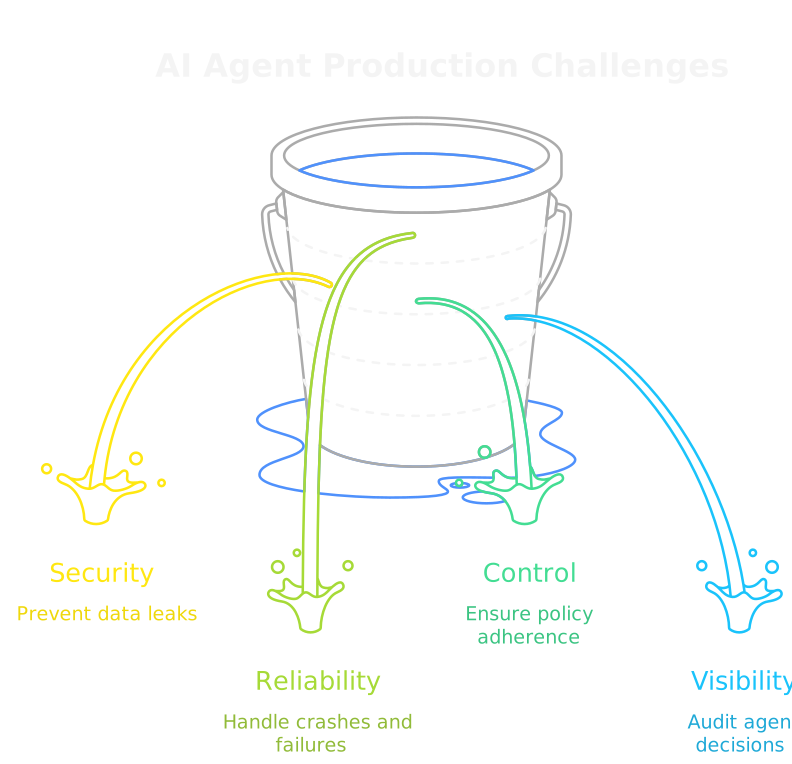
The Problem in Detail
When you deploy an AI agent without additional protection:
Agents Have Unrestricted Network Access
Your agent can call any URL. A prompt injection or buggy tool could:
- Exfiltrate sensitive data to unauthorized endpoints
- Hit internal services it shouldn't know about
- Rack up costs on pay-per-call APIs
- Violate compliance boundaries
Agents Run Arbitrary Code Paths
Unlike deterministic services, agents make runtime decisions. You can't predict every code path, which means:
- Standard allow-lists don't work
- Security reviews can't cover all behaviors
- Testing doesn't guarantee production safety
Agents Are Targets for Manipulation
Prompt injection is real. Malicious inputs can:
- Override system instructions
- Invoke tools in unintended ways
- Access data the user shouldn't see
You Have No Audit Trail
When something goes wrong, you need to answer:
- What did the agent do?
- What external calls did it make?
- Why was that decision made?
Without instrumentation, you're blind.
How AgentVisor Solves This
AgentVisor provides confinement and observability at the execution boundary — sandbox isolation, credential brokering, and policy governance deliver confinement; audit logging and durable execution deliver observability — without limiting what agents can do:
| Risk | Without AgentVisor | With AgentVisor |
|---|---|---|
| Network access | Unrestricted | All HTTP proxied through policy engine |
| Isolation | Container boundaries | Defense-in-depth: hardened sandbox + network isolation + optional syscall interception (gVisor) |
| Credential brokering | Environment variables | Symbolic tokens — real keys never enter sandbox |
| Principal-bound credentials | N/A | OAuth token exchange and JWT (JSON Web Token) passthrough for scoped tokens |
| Unauthorized APIs | Hope your code is right | Deny-by-default, explicit allow-list |
| Internal network access | Possible | Blocked at network level |
| Untrusted tool code (MCP) | npm/PyPI code runs in host process | Each stdio MCP server isolated in its own per-server sandbox (gVisor or Docker) |
| Audit trail | Build it yourself | Every request logged with full context |
| Policy decisions | None | Per-request PBAC (Policy-Based Access Control) evaluation |
Zero-Trust by Default
Agents in AgentVisor have no network access. None. Every HTTP request flows through a policy-controlled proxy. If it's not explicitly allowed, it's denied.
# Example: Allow only OpenAI and Anthropic APIs
resources:
  - name: llm-providers
    selector:
      - "mrn:agentvisor:http:api\\.openai\\.com.*"
      - "mrn:agentvisor:http:api\\.anthropic\\.com.*"
    group: "mrn:iam:resource-group:allowed"
Complete Host Isolation
Every agent runs in a hardened security sandbox with no access to anything not explicitly granted. Agents cannot reach the host filesystem, network, OAuth tokens, secrets, or any other resource unless policy explicitly permits it. All external communication goes through a policy-enforced proxy, ensuring complete control over agent capabilities. On Linux, gVisor provides the strongest isolation; Docker mode delivers an equivalent isolation boundary on any platform.
Defense-in-Depth Isolation
AgentVisor applies 14 independent security layers. The key layers include:
- Sandbox isolation: Container-based isolation prevents direct host access; in gVisor mode, a userspace kernel (gVisor) also intercepts every system call before it reaches the host kernel
- Network isolation: Agents have no direct network access — all traffic routes through the policy proxy
- Credential brokering: Real API keys never enter the sandbox — only symbolic tokens that are substituted at the host boundary
- stdio MCP server sandboxing: Each stdio MCP server (arbitrary npm/PyPI code) runs in its own per-server gVisor or Docker sandbox, preventing untrusted tool code from reaching the host trust domain
- Privilege separation: OpenSSH-style privsep with per-agent UID isolation prevents cross-tenant access
Additional layers include read-only filesystems, minimal Linux capabilities, seccomp syscall filtering, user namespace blocking, process visibility restrictions (hidepid), resource limits, environment variable curation, guest image hardening, and socket hardening. No single layer is perfect, but woven together they form a defense-in-depth approach that significantly raises the bar for any exploit to reach your infrastructure. See Sandbox Modes for details.
Next Steps
- Learn who AgentVisor is designed for and explore use cases
- Understand how it works under the hood
- Jump straight to the Tutorial guide